Here’s my take on LangChain vs LangGraph vs DeepAgents — how I’ve actually used them, what stood out for me, and when each fits best:
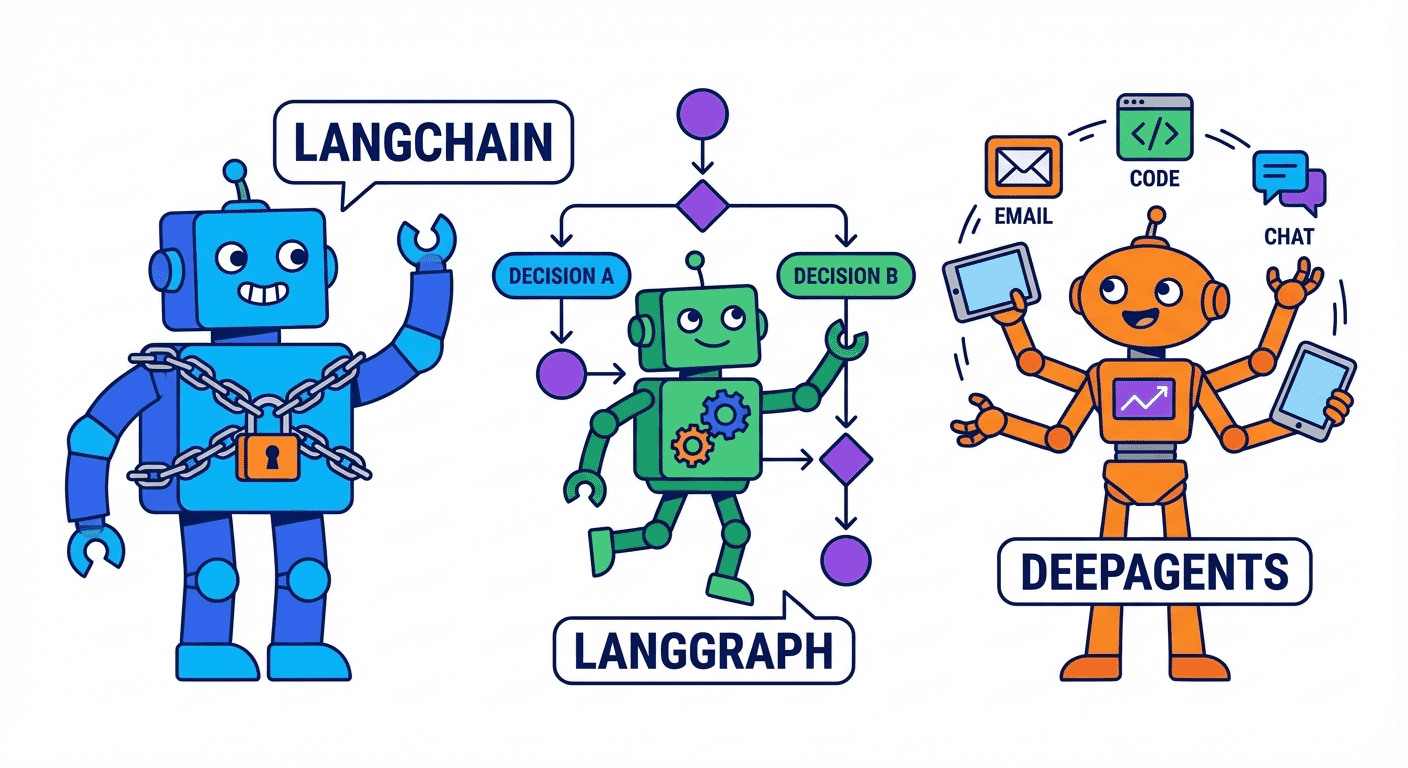
LangChain
I’ve used LangChain literally everywhere agentic logic is needed—still my go-to for experiments, workflows, and most AI automation work. It’s quick for chaining tasks, prototyping chatbots, retrieval pipelines—you name it.
But...if you’re using less mainstream model providers (like Groq, or when integrating Llama, Deepseek etc.), LangChain sometimes needed custom output parsing or error handling. The ecosystem was a bit fragile there, workflows would crash way more than I’d like if outputs weren’t perfectly formatted! For OpenAI or Gemini, things just work—output was clean, and using structured tools felt seamless.
The whole v1.0 update recently made things much neater for newbies—way better docs, tons of native integrations, and now docs even double up as a server for auto-complete in your IDE. Can vouch, it’s way easier for beginners now!
LangGraph
Started using LangGraph for workflows that looked like an absolute mess if I tried to build them as just chains: think multi-agent systems with custom routing, lots of conditional logic, pauses for human-in-the-loop, error retries. If your app needs to make “decisions,” or coordinate a bunch of specialists, this is where LangGraph shines.
It lets you model your state, routes, and transitions like a graph, not just a linear sequence—so you can branch, loop, retry, and recover gracefully in production. Build once, run reliably. I put it into prod for some complex Google Ads agent orchestration at work. Debugging is easier too, thanks to its LangSmith integration.
DeepAgents
Only started poking at DeepAgents recently, so my experience is mostly with smaller personal projects and tests. But it did surprise me: DeepAgents can handle mid to large agentic systems, spawning sub-agents, managing planning, and tool calls with very little boilerplate. The built-in toolsets and planning/scheduling logic help the agent work more autonomously.
For workflows where you want less hassle and just want the agents to plan, schedule, and act—DeepAgents gets it done with pretty solid reliability.
How I’d sum it up:
- LangChain is your handy linear workflow builder, best for prototypes and experiments.
- LangGraph comes into play for complex orchestrations and branching agentic logic—great for production environments.
- DeepAgents is the new kid, built for hands-off, autonomous agents that need planning and multi-agent coordination.
Each one’s helped me go from experiments to production, and I love having the choice depending on how wild my workflow gets!
Let me know if you need code snippets, visuals, or want to dive deeper into how I set up any of these!